Table of Contents
- Why Pacific Beach Is a Top Spot for Body Piercing
- What to Look for in a Professional Piercing Studio
- Same Day Piercing Services and Walk-In Policies
- Popular Piercing Styles and Placement Options
- Curated Ear Piercing Designs for Your Anatomy
- Choosing Safe Jewelry: Implant-Grade Titanium and Gold
- Piercing Aftercare Tips for Faster Healing
- Age Requirements and Parental Consent for Minors
- How Long We’ve Been Piercing in Pacific Beach
- Frequently Asked Questions
Last Updated: September 25, 2026
Why Pacific Beach Is a Top Spot for Body Piercing
Pacific Beach has become one of San Diego‘s most concentrated neighborhoods for body piercing. Between the boardwalk crowd, the college population, and a walkable stretch of shops along Garnet Avenue, there’s steady demand for studios that do the work properly. At Sandiegopiercingshops, we’ve watched that demand shift over two decades: clients who once wanted a single lobe now arrive with a plan for a full ear curation.
A professional piercing studio in Pacific Beach is not the same thing as a shop that happens to own a piercing gun. Walk the blocks near the beach and you’ll pass plenty of places offering jewelry and ink under one roof. Fewer can explain their sterilization cycle, their jewelry metallurgy, or why they’d turn a client away rather than pierce an ear that isn’t ready.
Below, we’ll cover what separates a safe studio from a risky one, how walk-in and same day piercing work, which styles suit which anatomy, and what aftercare should look like.
The single biggest predictor of a good piercing outcome isn’t the design you choose. It’s whether the person holding the needle can explain their sterilization process and the metal going into your body.
What to Look for in a Professional Piercing Studio
A professional piercing studio should be able to answer three questions without hesitation: how do you sterilize your tools, what metal is this jewelry, and what happens if something goes wrong during healing. If any answer is vague, leave.
Most clients never ask. They look at the portfolio, check the price, and sit down. But the visible parts of a studio, decor, jewelry case, Instagram feed, tell you almost nothing about whether you’ll heal cleanly.
The intake conversation is the real test. A studio that asks about your anatomy, sleep habits, contact sports, and past healing prevents problems. One that hands you a form and points at a chair does not.
Sterilization Standards and Autoclave Practices
An autoclave is a pressure chamber that uses steam at high temperature to kill bacteria, viruses, and fungal spores on reusable equipment. It is the standard method for sterilizing piercing tools, and it is not optional.
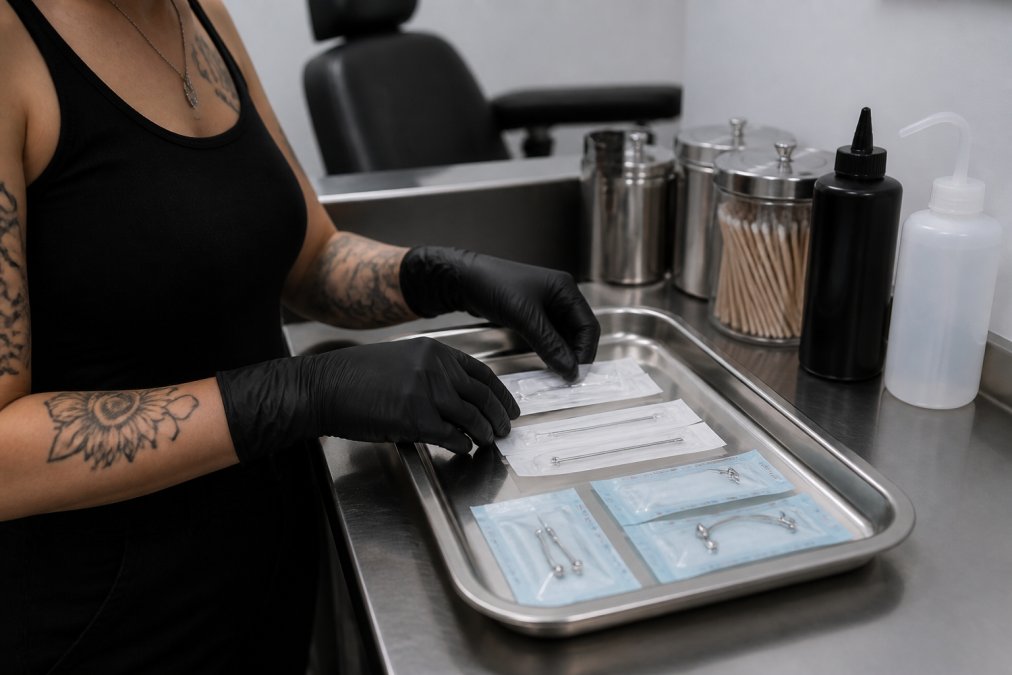
Equipment that touches you should come out of a sealed sterilization pouch with a chemical indicator strip showing the cycle ran correctly. Needles should be single-use and opened in front of you, and jewelry pre-sterilized and handled with gloves. If a piercer reaches into an open drawer for a needle, leave.
The CDC guidance on sterilization and disinfection in healthcare settings outlines the difference between cleaning, disinfection, and true sterilization. Piercing equipment falls into the sterilization category, not the wipe-it-down category. Many businesses find that clients who understand this distinction ask better questions and end up with better outcomes.
Needle Piercing vs. Piercing Guns
Needle piercing uses a hollow, single-use, sterilized needle that creates a clean channel through tissue and allows jewelry to be inserted without forcing. A piercing gun drives a blunt stud through the tissue using spring force.
The difference isn’t cosmetic. Guns cannot be fully sterilized the way an autoclave sterilizes equipment, and the blunt force causes more tissue trauma, longer healing, more irritation. Cartilage is especially unforgiving: a gun can crack the cartilage plate, and that damage doesn’t reverse.
We pierce with needles only. It’s slower, it requires more skill, and it’s the reason our clients heal the way they do.
Same Day Piercing Services and Walk-In Policies
Same day piercing is available at our studio, and walk-ins are welcome during all open hours. You don’t need to book weeks ahead to get pierced in Pacific Beach. Decide on a Tuesday afternoon that you want a helix, and you can likely be in a chair within the hour.
Walk-in availability depends on how busy the floor is, and Pacific Beach has a rhythm worth knowing. Weekday afternoons are easiest, the beach crowd hasn’t arrived and Garnet Avenue foot traffic is light. Weekend evenings get crowded fast, and a full ear curation takes far longer than a single lobe, so call or text ahead to check wait times.
If you want a specific piercer, placement, or multi-piercing session, book an appointment. It guarantees the time slot and lets us plan your jewelry in advance so the right gauge and length are sterile and waiting.
How a Walk-In Visit Actually Works
A walk-in isn’t a lesser version of an appointment, it’s the same procedure with less lead time:
- Check in at the counter. We’ll tell you the current wait and whether the piercer on the floor can take your placement. Some placements (daith, rook, dermal) need a piercer comfortable with that anatomy.
- Photo ID. Government-issued photo ID is required for every client, every visit, regardless of age. Minors need a parent or legal guardian present with their own ID plus documentation proving the relationship.
- Consultation and placement marking. Even on a walk-in, we mark the placement and let you approve it in a mirror before anything is opened. No needle comes out until you say yes.
- Jewelry selection. Initial jewelry is chosen for healing, not the final look. We’ll explain why the starter piece may be longer than what you’ll eventually wear.
- Piercing and aftercare walkthrough. We talk through the aftercare routine while you’re still in the chair, and you leave with written instructions.
When to Book Instead of Walk In
- Four or more piercings in one session. A curated ear takes real planning time before the first needle comes out, and walk-in slots rarely leave room for that conversation.
- A specific piercer. If you’ve been pierced by someone before and want them again, book it. Walk-in availability is whoever is on the floor.
- A specific date. Birthdays, graduations, and pre-wedding ear projects are appointment territory.
- A group. Two or three friends walking in together is usually fine on a weekday. A group of five or more should call ahead so we can stagger the chairs.
If you’re planning four or more piercings in one session, book it. A full curated ear takes real planning time before the first needle comes out, and walk-in slots rarely leave room for that conversation.
Same Day Piercing and the Neighborhood
Pacific Beach is a walkable neighborhood, which cuts both ways for a same day piercing. It’s easy to stroll in on impulse, and just as easy to stroll into a shop that treats piercing as an afterthought to its tattoo business. Same day convenience is only worth it if the studio has an autoclave on site, single-use needles opened in front of you, implant-grade jewelry in stock, and a piercer who asks about your anatomy before your design.
We’ve been piercing in Pacific Beach since 2002, handling same day walk-ins through every version of this neighborhood’s busy season. The process above is the same one we’ve used for two decades, and it’s why a walk-in here doesn’t feel rushed.
Popular Piercing Styles and Placement Options
The most requested piercings at our studio are lobe, cartilage, septum, nostril, and dermal, each with a different healing, pain, and aftercare profile. Choosing well means matching the style to your anatomy and lifestyle, not just the photo you saved.
The Styles We Pierce Most
- Lobe piercings: the fastest to heal and most forgiving, which is why they’re the standard first piercing. Placement can be high, low, stacked, or a row of three.
- Cartilage piercings: helix, conch, daith, tragus, and rook placements. Slower to heal and more sensitive to pressure from headphones, helmets, and side-sleeping. Not every ear has the ridge depth for every style.
- Septum piercings: placed through the thin tissue between the nostrils, not cartilage. Anatomy determines whether a ring sits straight or needs a different diameter, and a deviated septum can change the placement.
- Nostril piercings: a small stud or hoop through the nostril wall, with placement chosen to suit your nose shape rather than a fixed spot. The same piercing can look completely different from face to face.
- Dermal piercings: a single-point anchor set into the skin, typically on the cheekbone, chest, or back. These require a different aftercare approach because there’s no exit point, and they’re the most likely to reject over time.
How Much Does It Hurt? A Placement-by-Placement Guide
Pain is subjective, but there are consistent patterns. Most clients describe a sharp pinch lasting a second or two, followed by a dull ache for a few hours.
| Piercing Type | Typical Healing Time | Pain at the Moment | Main Irritation Risk |
|---|---|---|---|
| Lobe | 6-8 weeks | Low, often described as a quick pinch | Sleeping on it, tight earrings |
| Cartilage (helix, conch, daith) | 6-12 months | Moderate, a sharper pinch, longer ache after | Pressure, hair snagging, headphones |
| Septum | 6-8 weeks | Low to moderate, eyes water reflexively | Nose blowing, flipping jewelry |
| Nostril | 4-6 months | Moderate, similar to a cartilage pinch | Makeup, glasses, touching |
| Dermal | 3-6 months | Moderate, pressure more than sharpness | Friction, catching on clothing |
Those ranges assume you follow aftercare and don’t fiddle with the jewelry. A cartilage piercing that gets bumped daily can take well over a year. The pain column is a pattern, not a promise, the piercer’s speed and your anatomy matter more than the chart.
How to Prepare for Your Piercing
Preparation matters almost as much as the piercing itself, and it’s the part most people skip.
- Eat something within two hours. A drop in blood sugar is the most common reason clients feel lightheaded in the chair.
- Hydrate. Come in having had water that day.
- Skip alcohol and blood thinners. Alcohol thins the blood and increases bleeding. If you take a prescription blood thinner, talk to your doctor first.
- Wear your hair up if you’re getting an ear piercing, so it stays out of the way during and after.
- Don’t wear makeup around the piercing site. It has to come off before we can mark the placement.
- Bring a photo if you have one, but hold it loosely. Your anatomy decides the final placement, not the picture.
- Plan the rest of your day. You can go back to work after, but avoid the gym, the pool, and the ocean for the rest of the day.
Matching the Style to Your Anatomy
This is where a rushed studio fails you. You can’t plan a five-piercing ear by looking at a chart. You plan it by studying where your helix ridge sits, how much space your conch has, whether your daith is prominent enough to hold a ring, and how your lobe tapers. Two clients can request the same design and need completely different placements.
Some examples of what anatomy decides:
- A shallow conch bowl may not have room for a large ring without pressing on the ear’s inner curve.
- A flat, wide daith holds a ring well; a narrow one may need a smaller diameter or a different placement entirely.
- A thin helix ridge can reject a heavy piece over time, which is why we start with lighter jewelry.
- A deviated septum can push a septum ring off-center, and the fix is a different diameter, not a different piercer.
Our process starts with a consultation before any needle is involved. We map the ear, mark candidate placements, and talk through what each means for healing, jewelry sizing, and how it’ll look in six months once swelling settles. For clients building an ear over time, we stagger piercings so you’re never healing four sites at once.
Getting multiple cartilage piercings in one sitting because it’s convenient often backfires. Healing several slow sites simultaneously makes each one harder to keep clean and dramatically raises the odds of irritation bumps.
We’ve been piercing in Pacific Beach since 2002, and the placements we recommend today are the ones we’ve watched heal well for two decades, not the ones that photograph best on day one.
Curated Ear Piercing Designs for Your Anatomy
Curated ear piercing designs are planned arrangements of multiple piercings across one ear, chosen to follow the natural folds and curves of your anatomy rather than a template. The goal is balance, not volume.
Choosing Safe Jewelry: Implant-Grade Titanium and Gold
Implant-grade titanium is a biocompatible metal the body tolerates without the nickel reactions common to cheap fashion jewelry. It’s the safest default for a fresh piercing, and it’s what we stock for initial jewelry.
Biocompatible means the material doesn’t trigger an immune response or release harmful compounds into healing tissue. Surgical steel, sterling silver, and plated metals often fail that test for new piercings. Sterling silver can tarnish and leave permanent discoloration in a healing channel.
For healed piercings, solid gold is fine if it’s high enough purity and not plated. Hypoallergenic isn’t a regulated term, so ask what the metal actually is. If a studio can’t tell you the alloy, that’s a problem.
The FDA information on metal allergies and jewelry explains why nickel sensitivity is so common and why it matters for anything sitting inside your body for months.
Piercing Aftercare Tips for Faster Healing
Piercing aftercare tips that work are boring: clean gently, keep it dry, and leave it alone. Most irritation and infection cases we see come from over-cleaning, not under-cleaning.
Here’s the routine we give every client:
- Wash your hands before touching the area, every time, no exceptions
- Clean the piercing twice daily with a sterile saline wound wash
- Pat dry with a clean paper towel, don’t rub
- Don’t rotate, twist, or remove the jewelry during healing
- Avoid pools, hot tubs, lakes, and ocean water until fully healed
- Keep makeup, hair products, and lotions away from the site
- Sleep on the opposite side or use a travel pillow with your ear in the hole
- Don’t use alcohol, hydrogen peroxide, or antibiotic ointment
If you’re getting conflicting advice online, it’s because advice written for healed piercings gets recycled for fresh ones. Salt water soaks were standard years ago; today, a sterile saline spray in a can is more consistent and less likely to introduce bacteria.
For a professional piercing studio in Pacific Beach, the beach itself is a real aftercare factor. Ocean water isn’t sterile, and a fresh piercing exposed to it is a genuine infection risk. Wait until you’re fully healed before swimming.
Troubleshooting Common Aftercare Problems
- Redness and swelling in the first week: normal, especially on cartilage. It should ease, not escalate.
- An irritation bump beside the piercing: usually friction or pressure, not infection. Fix the cause (pillow, headphones, hair) before changing anything else.
- Crusting: normal. Soften it with saline, then wipe it away gently. Don’t pick.
- Yellow-green discharge with heat and throbbing: this needs a doctor, not a jewelry change.
- Jewelry sinking into the tissue: contact us immediately. This usually means the jewelry is too short for the swelling.
A travel pillow is the single most useful purchase for anyone healing a cartilage piercing. Sleeping with your ear in the hole removes the pressure that causes most irritation bumps.
Age Requirements and Parental Consent for Minors
Minors need a parent or legal guardian present, with government-issued photo ID for both the minor and the guardian, plus documentation proving the relationship. This is standard practice across reputable studios.
Age minimums vary by piercing type and studio policy. Earlobe piercings are generally available to younger clients with guardian consent, while cartilage, septum, nostril, and dermal piercings carry higher age thresholds because of the healing demands and aftercare responsibility involved.
The [American Academy of Pediatrics guidance on body piercing(/safe-body-piercing-for-beginners/) in adolescents | aap.org] is worth reading before bringing a child in. It covers healing expectations, infection signs, and the questions a parent should ask any studio. We’re happy to walk through our own consent process with you before you decide anything.
How Long We’ve Been Piercing in Pacific Beach
We’ve been piercing in Pacific Beach since 2002, which means we’ve watched trends arrive, peak, and disappear while the fundamentals of safe piercing stayed the same. That longevity is why we can tell you which placements fail on which anatomy, and why we stock the jewelry we do.
Two decades in one neighborhood also means we’ve pierced a lot of local families twice: once for a teenager’s first lobe, then again years later for a curated ear before a wedding. That continuity is the part of this work we value most.
We also operate alongside other long-standing shops in the area, including Sideshow Tattoo and Piercing, and we’d rather the neighborhood have several studios doing the work properly than one. You can see what they offer at Sideshow Tattoo and Piercing if you’re comparing options. Shop around. Ask the sterilization question everywhere you go. Then pick the studio whose answers you trust.
Choosing a piercing studio is a decision about who puts a permanent mark on your body, and the neighborhood has no shortage of options.
Frequently Asked Questions
How do I know if a piercing studio follows proper sterilization standards?
A reputable studio uses an autoclave for every reusable tool and opens single-use needles in front of you. Ask to see their spore test results, which verify the autoclave is working. The studio should also have a separate cleaning area and staff wearing fresh gloves. If a shop cannot answer basic questions about their sterilization process, walk away. Professional piercers are always happy to explain their safety protocols.
Do piercing studios in Pacific Beach accept walk-ins for same day piercing services?
Many Pacific Beach studios accept walk-ins, but availability depends on how busy they are. Calling or texting ahead is the fastest way to confirm a time slot. Some shops reserve certain hours for appointments and take walk-ins on a first-come basis. If you want a specific piercer or a complex curated ear piercing design, booking ahead is a safer bet than showing up unannounced on a weekend.
What is the 3/2 piercing rule for ear curation?
The 3/2 rule is a styling guideline, not a hard rule. It suggests grouping three piercings in one area of the ear and two in another to create visual balance. For example, three small studs along the lobe paired with two cartilage piercings higher up. A professional piercer will adapt this to your ear shape and anatomy rather than forcing a template that does not fit your unique structure.
Is it better to get pierced with a needle or a gun?
Needle piercing is the professional standard. A hollow needle creates a clean channel for jewelry and causes less tissue trauma than a gun, which forces blunt jewelry through the tissue. Guns also cannot be fully sterilized between clients in most cases, raising infection risk. For cartilage piercing especially, needles heal faster and have lower complication rates. Any studio using guns for body piercings is not following best practices.