
Table of Contents
- Why Implant Grade Jewelry Matters for New Piercings
- What Does “Implant Grade” Actually Mean?
- How to Verify Implant Grade Jewelry with Documentation
- ASTM F-136 Titanium Standards and What They Mean
- The Difference Between Surgical Steel and Implant Grade Titanium
- Is Titanium Always Implant Grade?
- Implant Grade Stainless Steel and Nickel Exposure
- Questions to Ask a Piercer or Seller
- What Visual Inspection Can and Can’t Tell You
- Care, Wear, and When to See a Professional
- How to Verify Implant Grade Jewelry: The Checklist
- Frequently Asked Questions
Last Updated: October 6, 2026
Why Implant Grade Jewelry Matters for New Piercings
In a fresh piercing, the jewelry sits inside an open wound. Implant grade jewelry meets a medical standard for what goes into the body, and it’s the difference between a piercing that heals and one that stays angry for months.
Implant grade jewelry meets a recognized medical implant standard, usually ASTM F-136 for titanium or ASTM F-138 for steel, which caps how much nickel the metal releases into your skin.
The metal isn’t a detail you pick at the end. It’s the single biggest factor in how fast a new piercing settles down, and it’s the one thing you can verify before you pay.
When the metal is wrong, cheap mystery metal releases nickel into the piercing channel, and the body reacts with swelling, crusting, and bumps that look like an infection but aren’t.
What Does “Implant Grade” Actually Mean?
Implant grade means the metal meets a published medical standard for surgical implants, not a marketing standard. Two standards matter most: ASTM F-136 covers titanium alloy for surgical implants, and ASTM F-138 covers stainless steel, including a controlled nickel range.
“Surgical steel” and “implant grade” are not the same claim. Surgical steel might just mean corrosion-resistant; implant grade means tested against a medical specification.
If a seller can’t tell you which ASTM standard their metal meets, treat the piece as unverified. The consequence isn’t just irritation. It’s a piercing that never fully heals, plus scar tissue you’ll be managing for years.
How to Verify Implant Grade Jewelry with Documentation
The only reliable way to identify implant grade jewelry is documentation: a mill certificate or material test report from the metal supplier, matched to the standard you’re buying.
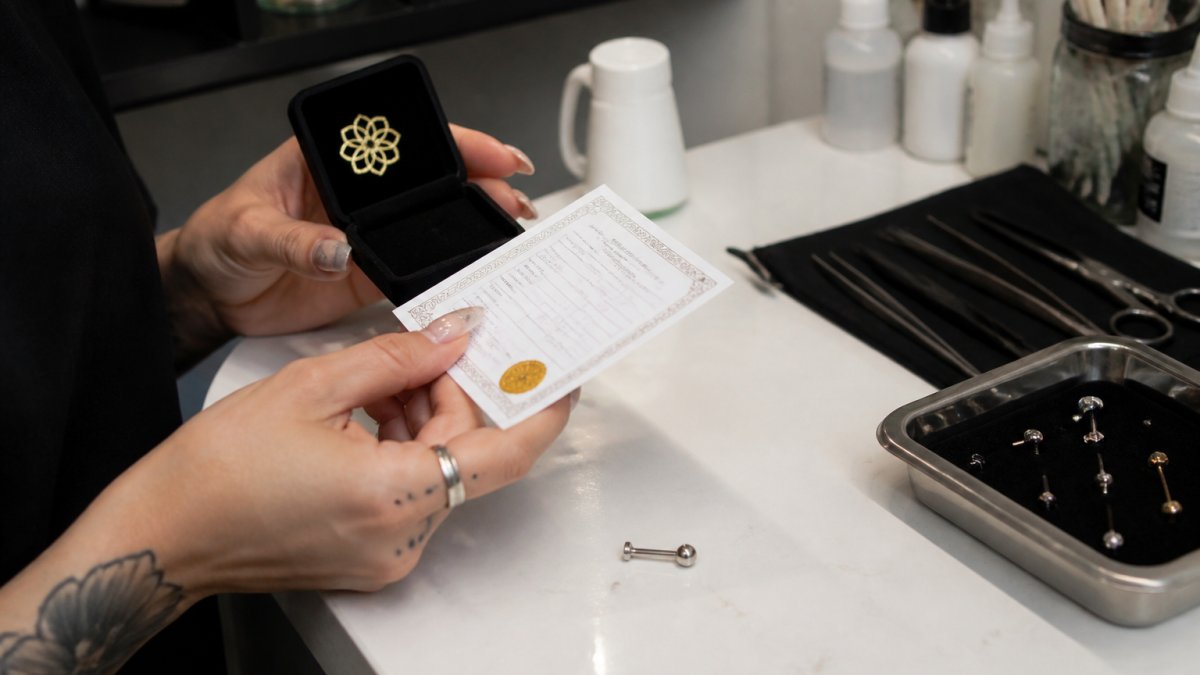
A mill certificate states the alloy, grade, and standard the raw metal meets. Reputable vendors keep these on file and will show you one.
A mill certificate usually covers a batch of raw metal, not a single finished piece. Ask whether the vendor can trace your specific jewelry back to the batch. Vendors who can do this tend to be the ones who care about the rest of the process too.
ASTM F-136 Titanium Standards and What They Mean
ASTM F-136 is the specification for wrought titanium alloy used in surgical implants, and it’s the standard we look for first.
F-136 doesn’t guarantee the piece is polished well, cover the threading or fit, or mean the seller handled it cleanly. For the exact wording, the ASTM F136 standard specification is the source to check.
The Difference Between Surgical Steel and Implant Grade Titanium
The core difference is nickel. Implant grade titanium is nickel-free by composition, while stainless steel contains nickel even in implant-grade versions.
Steel isn’t automatically bad, implant-grade steel under ASTM F-138 controls nickel release to a level most people tolerate.
| Feature | Implant Grade Titanium (F-136) | Implant Grade Steel (F-138) |
|---|---|---|
| Nickel content | None by composition | Present, controlled range |
| Weight | Lighter | Heavier |
| Best for | Fresh piercings, sensitive skin | Healed piercings, higher budget |
Titanium also takes anodized color, which is how you get gold, blue, or purple finishes without plating.
Is Titanium Always Implant Grade?
No. “Titanium” on a label means almost nothing on its own, it comes in many grades, most never intended to sit inside a human body. This is where mislabeling happens most. A seller writes “titanium” and the buyer assumes implant grade.
How to tell the difference: implant grade names the standard (ASTM F-136); generic titanium avoids naming any standard; “Grade 23” is common shorthand for the F-136 alloy and a good sign; “Ti-6Al-4V ELI” is the full alloy name and the strongest signal.
“Hypoallergenic” is not a standard. It’s a marketing word with no legal definition for jewelry. Don’t accept it in place of a material specification.
Implant Grade Stainless Steel and Nickel Exposure
Implant grade stainless steel is a real category, not the cheap steel in a mall kiosk. Under ASTM F-138, the alloy is 316LVM, a vacuum-melted steel with controlled nickel release, used in surgical implants. The catch is nickel. Some people react even at implant-grade levels, redness, itching, and a bump that won’t quit, and it can develop after years of wearing steel with no problem.
Questions to Ask a Piercer or Seller
You don’t need to become a metallurgist. You need four questions and the willingness to walk away if the answers are shaky. Ask: Which ASTM standard does this metal meet? Can I see the mill certificate or material test report? The Association of Professional Piercers jewelry standards publishes guidance on what to look for in body jewelry.
What Visual Inspection Can and Can’t Tell You
Your eyes can catch some problems, but they can’t confirm a grade. You can spot a mirror polish with no scratches or pits, smooth edges, no flaking on colored pieces, and a snug fit. You can’t spot the alloy composition, whether the metal meets any standard, nickel content, or whether a mill certificate exists.
Care, Wear, and When to See a Professional
Don’t sleep on a new piercing if you can avoid it, if you must, use a travel pillow with your ear in the hole. Clean with sterile saline spray, not homemade salt water. Don’t twist or rotate the jewelry; that damages the healing channel. Keep makeup, hair products, and perfume away from the site, and don’t swap jewelry until a piercer says it’s healed.
Downsize on schedule. A piercer will often fit a slightly longer post at first to allow for swelling, then swap to a shorter one once things settle. Skipping that second appointment is a common cause of irritation bumps.
How to Verify Implant Grade Jewelry: The Checklist
Run this before you buy anything, every time. Confirm the metal names a specific standard (ASTM F-136 or F-138), ask for the mill certificate, check the alloy name matches the standard, confirm the finish is polished rather than plated or coated, and for fresh piercings default to implant grade titanium.
The jewelry you choose in the first week shapes how the next six months go, and the difference between a smooth heal and a stubborn one usually comes down to metal you can verify. If you’d rather not sort through the standards yourself, our body piercing service handles the whole thing, we’ve been fitting implant-grade jewelry since 2002, and we’ll walk you through the standard, show you the documentation, and help you pick a piece that fits.
Frequently Asked Questions
Is ASTM F-136 titanium the same as implant grade?
Yes. ASTM F-136 is the standard specification that defines implant grade titanium for surgical implants. If a piece of jewelry is labeled ASTM F-136, it meets the chemical composition, mechanical properties, and biocompatibility requirements for implant grade titanium. Any jewelry claiming to be implant grade titanium should carry this designation on its certificate or packaging.
How can I tell if my jewelry is surgical steel or implant grade titanium?
Visual inspection alone cannot reliably distinguish the two. Surgical steel may contain higher nickel levels and does not meet ASTM F-138 or F-136 standards. Implant grade titanium is lighter, non-magnetic, and should come with documentation listing ASTM F-136 compliance. Ask your piercer for the mill certificate or manufacturer specification sheet to confirm the material grade.
Can I trust online listings that claim to be implant grade?
Not without verification. Many online sellers use ‘implant grade’ as a marketing term without documentation. Look for listings that provide ASTM F-136 or F-138 certification, name the manufacturer, and are sold by APP verified jewelry vendors. If a listing lacks a material certification or refuses to share one, treat the claim as unverified.