

Table of Contents
- How Piercing Placement for Ear Anatomy Actually Works
- How to Tell If My Ear Anatomy Is Suitable for Industrial Piercings
- Ear Piercing Healing Time by Location
- Choosing High-Quality Jewelry for New Piercings
- Styling Your Earscape Without Fighting Your Anatomy
- Frequently Asked Questions
Last Updated: September 30, 2026
How Piercing Placement for Ear Anatomy Actually Works
Can I sleep on a new ear piercing? Not comfortably, and not on the pierced side. Piercing placement for ear anatomy starts with one fact: your ear is a set of ridges, folds, and curves, and each one decides what will heal well and what will not.
At Sandiegopiercingshops, we have pierced ears since 2002, and the questions we hear most are practical: Will it heal? Can I sleep on it? Will it look right on my ear?
Placement is not a style choice layered on top of anatomy. Anatomy decides placement first. Style comes second.
How to Tell If My Ear Anatomy Is Suitable for Industrial Piercings
An industrial piercing needs a cartilage ridge thick enough and curved right to support a single bar through two holes. A piercer checks the helix fold’s depth, the angle between the two points, and whether a straight bar sits without pressing into the flat of the ear.
If the fold is too shallow or the curve too tight, a traditional industrial pulls on the tissue, causing migration where the jewelry slowly moves and the piercing never settles.
A common mistake is choosing an industrial from a photo without checking whether the ridge can hold it. Many people who want one are better suited to a different layout on the same ear.
A suitability check: the piercer looks at the helix fold from front and side, feels the ridge to judge thickness, marks two points to check a straight line connects them, checks for scar tissue in the way, then tests the angle with a mock bar before any needle is used.
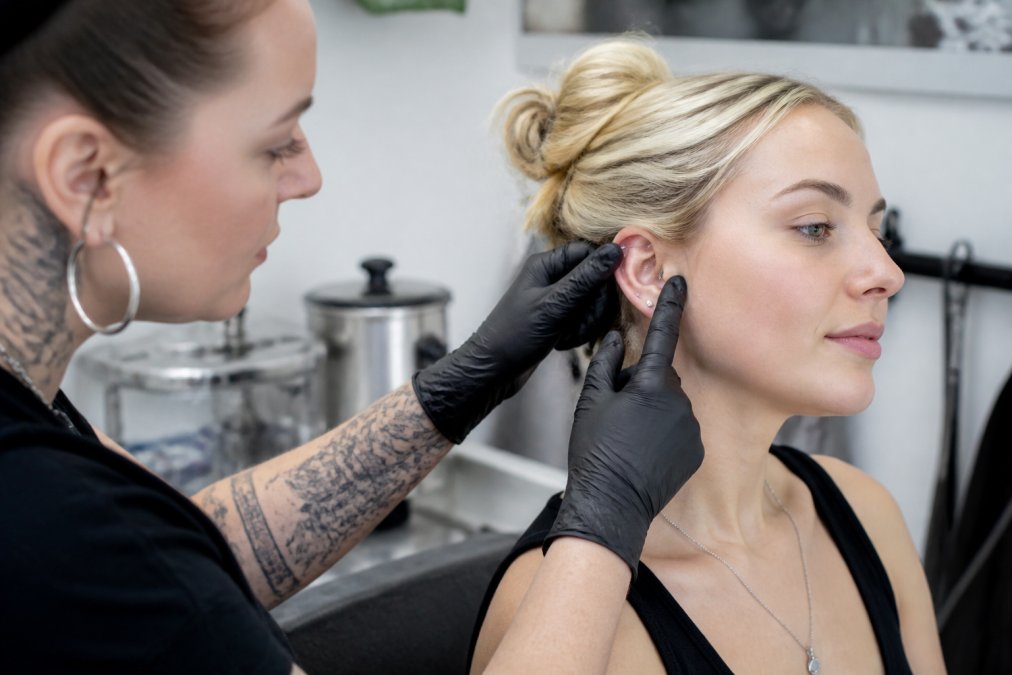
If a piercer will not mark and check before piercing, leave. A rushed assessment is how people end up with a piercing that never heals.
Ear Piercing Healing Time by Location
Healing time depends on where the piercing sits. Lobe piercings heal fastest because they pass through soft tissue with good blood flow; cartilage piercings heal slower because cartilage has far less blood supply.
| Location | Typical Healing Time | Why It Varies |
|---|---|---|
| Earlobe | 6 to 8 weeks | Soft tissue, good blood flow |
| Helix | 6 to 12 months | Cartilage, slow blood supply |
| Conch | 6 to 12 months | Thick cartilage, pressure from sleep |
These ranges are general. A piercing at a bad angle, or one slept on every night, can take far longer; one that sits cleanly and is left alone often heals at the faster end.
Cartilage healing is not a straight line. A helix can feel fine for three weeks, then swell and ache for a week, then settle again. That is normal, not a sign of infection on its own.
Sleeping on a new cartilage piercing is the most common reason healing stalls. The pressure pushes the jewelry against the tissue all night, which causes irritation bumps and, over time, migration. If you cannot avoid sleeping on that side, a travel pillow with your ear in the hole is the practical fix.
Choosing High-Quality Jewelry for New Piercings
Jewelry material matters more for a fresh piercing than any other piece you own. A new piercing is an open wound, and the metal sits inside it for months. Implant-grade titanium and niobium are what most piercers reach for, because they sit in the body without reacting to it.
The shape matters as much as the metal. A hoop in a fresh cartilage piercing can rotate and drag bacteria into the channel; a flat-back stud moves less, giving the tissue a chance to settle.
Bring a photo of the jewelry you want, but let the piercer pick the gauge and length. The look you want and the size your ear needs are often two different numbers, and the piercer is the one who can see the difference.
Styling Your Earscape Without Fighting Your Anatomy
A curated ear is built around what your ear already has. The best earscapes use the natural ridges as a frame: a helix along the outer fold, a conch tucked into the bowl, a tragus or rook where the cartilage is thick enough to hold it.
Frequently Asked Questions
Can I sleep on a new ear piercing?
Not on the pierced side. Pressure restricts blood flow, irritates the channel, and is a leading cause of bumps and migration. Sleep on the opposite side or use a travel pillow with your ear in the hole. Cartilage piercings can take 6 to 12 months to heal, so plan for months of careful sleeping, not days.
How long does it take for an earlobe piercing to heal?
Lobe piercings typically heal in 6 to 8 weeks because the tissue is soft and has good blood flow. Cartilage piercings, including helix, conch, daith, and rook, take 6 to 12 months. Cleaning twice daily with sterile saline and avoiding pressure or tugging gives each spot the best chance to heal on schedule.
How do I know if my ear anatomy suits a specific piercing?
Look at the fold, curve, and thickness of the area you want pierced. An industrial needs a prominent helix ridge with enough room for a straight bar. A daith needs a defined inner cartilage fold. A piercer examines your ear in person and confirms whether the jewelry sits at a safe angle before piercing.
Piercing placement for ear anatomy is not a trend you follow. It is a decision your ear makes for you, and the piercer’s job is to read it. If you want a placement plan built around your actual anatomy, with implant-grade jewelry and a piercer who takes the time to map it first, Sandiegopiercingshops has been doing exactly that since 2002. Call or text (858) 222-0071 to book a consultation, and bring your questions about healing, sleeping, and jewelry with you.